The Strategic Transformation of Space in 2025
Recent developments warrant reassessment of prevailing assumptions about space operations


Space activity in 2025 demonstrated that the domain can no longer be treated as a support layer for terrestrial operations. Major powers are developing the means to impose costs directly in orbit. As a result, space systems must now be evaluated in terms of survivability, contestability, and deterrent value, not only utility.
Launch Capacity and Industrial Scale as Strategic Variables
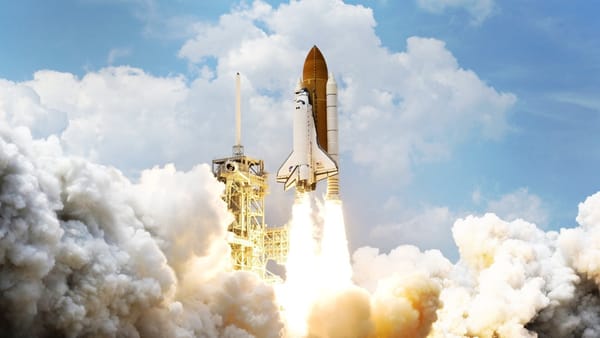
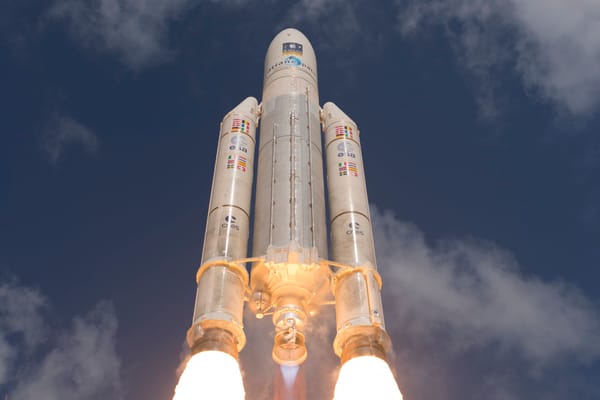
Reusable launch systems are not primarily a commercial milestone; they reduce the time and cost required to reconstitute orbital assets. In a conflict environment, rapid launch capacity undermines strategies based on attrition of satellites. The state that can restore degraded capability faster than it loses it gains escalation resilience.
Short-interval multi-launch demonstrations are significant because they signal range flexibility, integration maturity, and supply chain depth. These are prerequisites for sustained wartime replenishment. Launch frequency has therefore become a measurable indicator of strategic readiness.
The ability to manufacture and deploy large numbers of satellites confers resilience. A proliferated architecture can absorb losses without catastrophic degradation of mission performance. Competition is therefore shifting from qualitative advantage alone toward industrial throughput and replenishment capacity. Strategic endurance in space increasingly depends on production depth rather than platform singularity.
Maneuver, Servicing, and the Erosion of Orbital Stability
Repeated rendezvous and proximity operations (RPO) indicate that close approach capability is transitioning from experimental to operational practice. Once normalized, RPO provides a non-kinetic method to threaten, inspect, interfere with, or disable satellites without overt missile use.
The strategic consequence is ambiguity. The same maneuver can constitute routine servicing, intelligence collection, or preparation for hostile action. This ambiguity complicates deterrence and increases the risk of miscalculation.
If on-orbit refueling is demonstrated and sustained, it alters the temporal logic of satellite competition. A maneuvering satellite no longer faces fuel exhaustion as a limiting factor. This enables persistent presence near sensitive targets.
Geostationary orbit has historically been treated as comparatively stable because satellites there were largely fuel-limited and positionally predictable. Demonstrated maneuver and servicing activity in GEO undermines that assumption. If complex maneuver becomes routine in GEO, high-value systems such as strategic communications and missile warning will operate under persistent proximity risk.
Homeland Defense and the Militarization of Space Architecture
Emerging homeland defense concepts rely heavily on space-based sensing, communications, and potentially intercept functions. This places space systems at the center of national defense narratives rather than at the periphery.
Any move toward space-based interceptors will be interpreted not only as defensive adaptation but as a shift in the balance of counterspace potential. Even if technically limited to missile defense roles, such systems will influence strategic stability calculations.
Explicit discussion of warfighting roles in space is becoming normalized. As states openly acknowledge offensive and defensive space capabilities, political barriers to capability development will diminish. The consequence is a more candid but also more competitive security environment.
Orbital Congestion and Space Traffic Management as Strategic Infrastructure
The sustained increase in payload deployments has produced a dense LEO environment characterized by frequent close approaches. Near-miss events at small separation distances are no longer statistical anomalies; they are routine operational occurrences. When collision avoidance becomes a daily requirement, system robustness depends on high-fidelity tracking and rapid information exchange. Absent those conditions, the probability of cascading debris events increases. Congestion therefore represents both a safety and a strategic sustainability problem.
Objects that are not rapidly cataloged or clearly characterized create operational and political risk. Operators cannot maneuver responsibly against unknown trajectories, and near-miss events involving poorly tracked satellites invite accusations of deliberate concealment. Transparency deficits thus amplify both collision probability and geopolitical suspicion. In a contested environment, the absence of reliable tracking data can itself become destabilizing.
As object density increases, centralized coordination and authoritative data integration become more valuable. Reductions in institutional capacity dedicated to civil space situational awareness create gaps precisely when the operational environment requires greater integration. In a high-congestion regime, fragmented tracking responsibilities and uneven data access increase systemic risk. Space traffic management is no longer an administrative convenience; it is infrastructure for orbital stability.
Non-Kinetic Interference and Civil Vulnerability
GPS and other positioning signals are increasingly subject to deliberate interference. While jamming may offer tactical advantages, it affects civil aviation and maritime systems that rely on the same signals.
The expansion of navigation warfare beyond confined battlefields increases the likelihood of serious civilian incidents. Such incidents would occur in politically charged contexts, raising the probability of escalation or misattribution.
Commercial space domain awareness providers can now generate and publish unclassified evidence of proximity operations and anomalous behavior. This reduces the ability of states to operate covertly in orbit. Publicly available tracking data strengthens attribution but also accelerates political pressure for response.
Emerging Patterns for 2026
Three patterns merit close observation:
- Deliberate deception in orbital behavior, including insertion ambiguity and signature manipulation, will likely expand. Such tactics increase the analytical burden on tracking systems and obscure operational intent.
- Constellation proliferation will intensify tracking complexity. More objects increase the space within which deceptive or hostile actions can be concealed.
- Artificial intelligence will be integrated more deeply into mission planning, anomaly detection, and traffic analysis. As object counts rise, human-centric monitoring will become insufficient without algorithmic augmentation.
Conclusion
Space is transitioning from a domain assumed to be permissive and predictable to one characterized by maneuver, ambiguity, and strategic signaling. Deterrence in this environment will depend on three interrelated capacities: persistent awareness, rapid reconstitution, and credible cost imposition.
Any framework that continues to treat orbital systems as insulated from geopolitical rivalry risks strategic surprise.
Sources
- Frazier, Tony, John Huth, Kari A. Bingen, and Clayton Swope. “Space ‘Year in Review’: A 2025 Recap and 2026 Outlook.” Panel Discussion. December 18, 2025.