Is Space Superiority the Cornerstone of Future Warfare?
The U.S. Space Force’s new framework marks a turning point in how Washington views the contested domain of space

The United States has long depended on space to support its military, economic, and societal functions. What was once treated as a supporting domain is now formally recognized as a critical arena of competition, one where superiority is no longer optional but essential. The recently released Space Warfighting Framework by the U.S. Space Force marks a decisive step in defining what space control and superiority mean in practice, and how the nation intends to achieve them.
From Supporting Role to Supported Command
Since the late 1990s, successive studies, from the Rumsfeld Commission to the establishment of U.S. Space Command, have emphasized the growing interdependence of space and missile defense. The culmination of these reforms was the creation of the U.S. Space Force (2019) and the re-establishment of U.S. Space Command as a unified combatant command (2020).
The new framework outlines a shift: space is no longer viewed solely as a supporting function to air, land, and sea forces. Instead, the Space Force is asserting its role as a supported command, with both defensive and offensive responsibilities. This cultural change aims to accelerate integration of space into joint force planning, force generation, and operational posture.
Defining Space Superiority
At the heart of the framework is the concept of space superiority—the ability of the U.S. and its allies to operate in space at a time and place of their choosing, while denying adversaries the same freedom. Achieving this depends on space control, which includes both defensive measures (protecting satellites and networks) and offensive operations (denying adversaries’ use of space).
For the first time in an unclassified document, the Space Force acknowledges the need for offensive space control. This move parallels the Air Force’s recognition that air superiority is a prerequisite for all other forms of power projection. Without secure access to space, the joint force cannot operate effectively on land, at sea, or in the air.
The Threat Landscape
The counterspace environment is expanding. What began with a handful of nations testing anti-satellite weapons has grown into a global proliferation of capabilities. Today, twelve countries are developing or fielding counterspace technologies, ranging from co-orbital systems and direct-ascent interceptors to directed energy, electronic warfare, and cyber tools.
While no destructive anti-satellite attacks have been used in conflict, non-destructive measures, like jamming, spoofing, and cyber intrusions, are now routine, cheap, and deniable. Rendezvous and proximity operations in orbit by major powers further blur the line between legitimate space activity and potential attack.
This creates a paradox: destructive counterspace use is rare and escalatory, but non-destructive interference is frequent and destabilizing. Without red lines or agreed norms, the risk of inadvertent escalation rises.
Allies, Partners, and Norms
The framework highlights the role of allies and partners. Nations from Japan to France have established military space units, while initiatives such as Operation Olympic Defender seek to coordinate planning and responses among likeminded states. Yet disagreements persist over terminology. The U.S. defines space as a warfighting domain, while allies such as NATO refer to it as an operational domain. This semantic divide has diplomatic consequences: Russia and China exploit U.S. language to portray Washington as the driver of space weaponization.
Equally critical is classification. Excessive secrecy constrains collaboration. Strategies to minimize unnecessary classification—while protecting sensitive details—are essential if the U.S. hopes to integrate partner contributions into joint space operations.
Commercial Dependencies and Risks
No assessment of space security can ignore the commercial sector. American companies dominate global space launch and satellite constellations, with private actors such as SpaceX deploying more satellites since 2019 than the rest of the world combined. This dominance is both a strength and a vulnerability.
The Ukraine war exposed the risks of reliance on commercial providers when decisions on satellite service availability—normally the domain of states—were made by private executives. The U.S. is now seeking to formalize relationships through mechanisms such as SpaceX’s Starshield contracts, but questions remain about how to balance innovation, reliability, and state authority.
Rules of Engagement and Escalation
The framework calls for more flexible rules of engagement, allowing Guardians to act rapidly without awaiting higher-level approval. This reflects the speed of space conflict, where decisions must be made in seconds rather than days. Yet it also raises concerns about escalation.
Unlike the U.S., which views escalation as a linear ladder, Russia and China treat it as a dial that can be turned up or down. Misaligned perceptions of signaling could turn limited actions into unintended crises. The framework acknowledges this challenge but leaves much work ahead in defining rules that deter adversaries without inviting miscalculation.
Deterrence and Denial
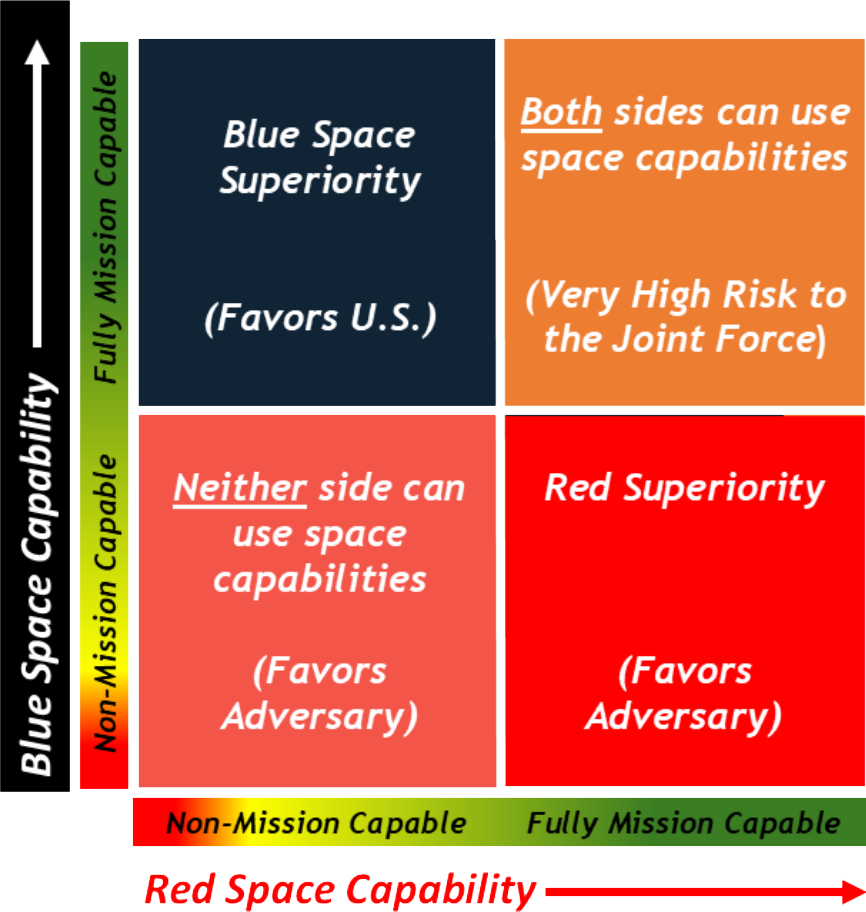
One of the framework’s most striking points is that mutual denial of space does not create stalemate, it favors the adversary. Because the U.S. is more dependent on space than any other actor, the loss of satellites would undermine both military operations abroad and civilian life at home. From GPS navigation to financial networks, communications, and weather forecasting, a day without space would paralyze the American economy and society.
The Path Ahead
The Space Warfighting Framework represents an important milestone: an unclassified articulation of U.S. doctrine that openly acknowledges the necessity of offensive space control, integration with allies, and the centrality of commercial partners. Yet it also exposes dilemmas: how to deter without arms racing, how to integrate allies across differing doctrines, and how to balance secrecy with transparency.
Space is now indispensable to both daily life and military power. The U.S. and its allies cannot afford to lose it. Whether the framework succeeds will depend on how effectively its principles are translated into practice across doctrine, technology, diplomacy, and partnerships.
Sources
- Atlantic Council. 2025. Experts Read Between the Lines of the US Space Force’s Warfighting Framework. Atlantic Council. August 13.
- Roulette, Joey, Cassell Bryan-Low, and Tom Balmforth. 2025. Musk ordered shutdown of Starlink satellite service as Ukraine retook territory from Russia. Reuters. July 27.
- SpaceX. n.d. Starshield: Supporting National Security. Accessed August 18, 2025.
- United States Space Force. 2025. Space Warfighting: A Framework for Planners. Washington, DC: United States Space Force.
- U.S. House. Committee on National Security. 1998. Findings and Conclusions of the Commission to Assess the Ballistic Missile Threats to the United States: Hearing before the Committee on National Security, House of Representatives, One Hundred Fifth Congress, Second Session, July 16, 1998. Washington, DC: U.S. Government Printing Office.
- U.S. Space Command. n.d. Multinational Force Operation Olympic Defender. Accessed August 18, 2025.